BlogMarketing
AI Is Now Reading Your Emails Before Humans
For decades, email marketing assumed humans were the first readers. That assumption is breaking—and most teams haven't fully adjusted.
Old assumption
Sender → Recipient. Humans read first.
New reality
Sender → AI systems → Recipient. Machines evaluate first.
What wins now
Relevance, context, and conversations—not repetition at scale.
Opening
The human reader is no longer the first audience
For decades, email marketing was built around a simple assumption: humans were the first readers.
That assumption is breaking.
Today, before a person sees your email, AI systems categorise it, summarise it, filter it, prioritise it, and decide whether it deserves attention at all. Most marketing teams still plan as if the human is first. They're optimising for an inbox that no longer works that way.
The human reader is no longer the first audience. That changes the game—not eventually, but now.
This article explains why templates struggle in AI-mediated inboxes, and what replaces them. If you want the broader shift first, read why template-based marketing is breaking.
The inbox
The inbox has changed
Most marketers still picture email like this:
The model most teams still plan for
But the path looks more like this today:
Where your email is actually interpreted first
Increasingly, inboxes don't present emails as full messages first. They present previews, summaries, categorised snippets, and AI-generated highlights. The full email often becomes secondary.
You've probably already seen this:
- Gmail tabs that sort Promotions before your message is opened
- Preview snippets that replace your subject line in the inbox list
- AI-generated summaries that compress a full email into one line
- Priority inboxes that surface only what the system thinks matters
- Filtering layers that treat repetitive sends as bulk marketing
Behind the scenes, AI systems now influence:
- Inbox placement and categorisation
- Preview text and snippet generation
- AI summaries and compression
- Prioritisation and attention scoring
- Spam and pattern detection
Already happening
This isn't a future inbox. Gmail categorisation, AI summaries, and skim-first reading are normal for millions of users today. The shift didn't arrive with a press release—it arrived in the inbox people already use.
Even when an email is "delivered," it may never really be seen—compressed into a summary, buried in Promotions, or indistinguishable from the ten messages beside it.
Your email is no longer competing only against other marketers. It's competing against how AI interprets it.
Templates
Why templates struggle in this environment
Templates were designed for operational scale: one message, many recipients, predictable execution. That made sense when humans were the first readers.
AI systems, by contrast, are extremely good at detecting repetition and patterns. The more predictable your communication becomes, the more machine-like it appears.
Repeated across campaigns:
- Subject lines that repeat across sends
- Structures and layouts that look the same
- Phrasing pulled from the same playbook
- Timing and sequencing that never varies
…creates recognisable fingerprints. Systems learn to treat them as bulk marketing.
The very thing marketers optimised for—consistency—may now reduce visibility.
Summaries
AI summaries flatten differentiation
Even strong emails can lose impact when the inbox doesn't show them whole. Modern clients increasingly preview, summarise, and compress content before anyone opens. Carefully crafted campaigns often become generic snippets, predictable summaries, and interchangeable messages in a crowded feed.
Three different emails. One AI summary.
Email 1
"Introducing our newest productivity workflow…"
Email 2
"See how teams automate onboarding in minutes…"
Email 3
"Your weekly feature update is here…"
AI summary in the inbox
"Platform update and onboarding tips."
Same sentence. Three different sends. Differentiation gone.
If your email can be summarised into the same sentence as everyone else's, differentiation disappears.
Segmentation
Why segmentation is no longer enough
Segments were a reasonable compromise when you couldn't personalise at scale. But they're still broad buckets:
- New users
- Active users
- Enterprise leads
- Churn risk
Real behaviour is more contextual:
- What someone did yesterday
- What they ignored or skimmed
- What they nearly completed
- What matters to them right now
Two users inside the same segment may need completely different conversations.
Context
The shift from campaigns to context
Traditional marketing systems were designed to broadcast. You plan a calendar, build a sequence, and push the same message to thousands of people—maybe with a segment or a first name swapped in.
Modern systems increasingly need to respond. Not with better schedules or more templates, but with communication shaped around individual context: what someone did yesterday, what they ignored, what they nearly finished, what matters to them right now.
This is the category shift underneath everything else in this article. It's not a feature upgrade. It's a different way of thinking about email altogether.
Old world
- Campaigns and blast sends
- Fixed sequences and funnels
- Templates and A/B at campaign level
New world
- Adaptive messaging
- Contextual generation
- Continuous learning and individual journeys
Campaigns
- One message to many
- Optimise after the send
- Segments as the unit of relevance
Conversations
- One message per person
- Adapt before and during the journey
- Individuals as the unit of relevance
You're no longer broadcasting messages. You're responding to people—with timing, tone, and content that reflects their actual situation.
The future isn't better templates. It's systems that understand context continuously.
Traditional Email Tools
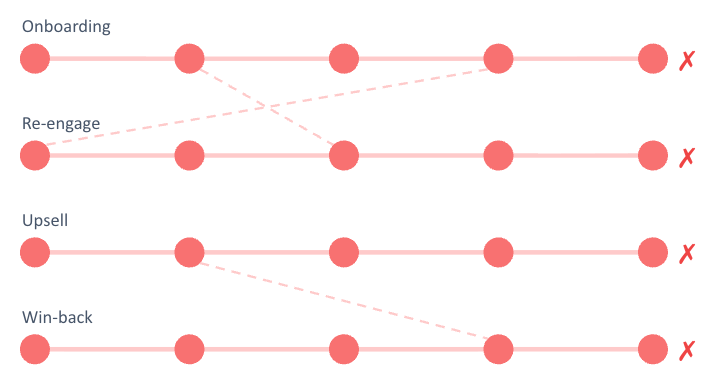
Rigid sequences force customers into predefined funnels. If they fall off the track, their journey stalls.
Drip Magnet
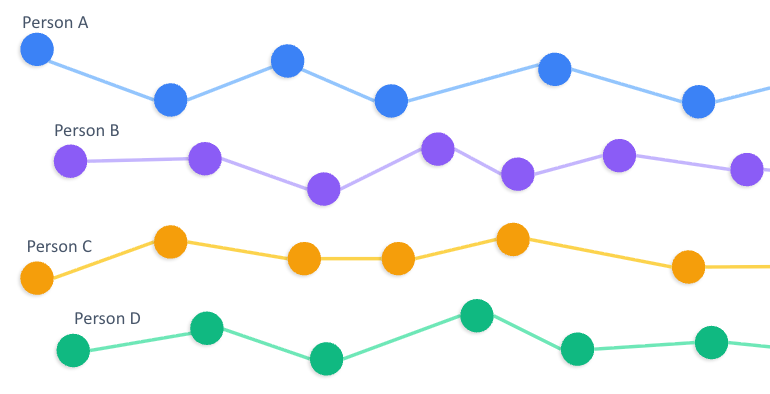
Every person's journey is unique. They move, branch, and reconnect — always relevant.
What's next
What replaces template marketing
A new model is emerging—not as a gimmick, but as a response to how inboxes actually work. Systems like Drip Magnet are part of that shift: built for AI-mediated delivery and human relevance at the same time.
Modern approaches:
Connects to behavioural data
- CRM and product usage
- Lifecycle events
- Real-time signals
So each message reflects what someone has actually done—not just which bucket they sit in.
Understands context continuously
- Where they are in their journey
- What they've completed or stalled on
- What's relevant in this moment
Generates unique emails per person
- Written for one recipient, not a segment
- Adapted to individual state
- Aligned with brand voice and rules
Not a mail-merge variation—a fresh message shaped by context.
Applies guardrails and control
This isn't spray-and-pray AI.
You define:
- Tone and brand boundaries
- What can and can't be said
- Approval workflows where you need them
Controlled adaptive communication—not unreviewed output at scale.
Learns and improves over time
- Performance feeds back into messaging
- Patterns adjust dynamically
- Systems get sharper with every send
Closing
The new reality
Templates made sense when humans were the first readers. Today, AI systems increasingly decide what gets surfaced, what gets summarised, and what gets ignored.
That means:
- Relevance matters more than repetition
- Context matters more than consistency
- Adaptive communication matters more than campaigns
The era of template-driven marketing is ending. The next generation of email systems won't optimise campaigns—they'll optimise relevance, one conversation at a time.
In a world where AI reads your emails before humans do, the winners won't be the loudest senders. They'll be the systems that feel the most relevant.
Related reading
Why Template-Based Marketing Is Breaking(And What's Replacing It)
Templates were built for scale, but today's inboxes reward context, relevance, and per-person communication instead.
Why Most Email Automation Is Broken(And What We're Building Instead)
Broadcast drips look personalised but treat everyone the same. Here’s why that breaks—and how we think about fixing it.